Record vs. Action: The Land Grab in GTM Tech by Brendan Short
Warmly, Common Room, Pocus: three acquisitions, one pattern — the independent middle layer is disappearing into the record.



In the past 12 months, HubSpot bought Warmly. Zoom bought Common Room. Apollo bought Pocus. Salesforce bought Momentum, Bluebirds, and Qualified, and paid $3.6B for Fin. Koala’s team joined Cursor.
Not one of these buyers was a private equity (PE) firm.
In the previous wave of GTM tech consolidation, PE wrote the checks. Between November 2020 and December 2021, Vista alone took Gainsight (for roughly $1.05B), Drift (majority stake, at a $1B+ valuation), and Salesloft (for $2.3B). This time, the platforms are shopping. The buyer tells you what the asset is.

The Last Wave Sold to PE
Then came the roll-up inside the roll-up. Drift got folded into Salesloft in 2024, and Salesloft merged with Clari in 2025, creating a combined entity with around $450M ARR.
Think about what a PE purchase signals. PE firms buy companies they can underwrite as durable standalone businesses: strong retention, predictable revenue, a credible path to being run for cash flow. Profits, in other words, or the believable promise of them. (A concept we rarely talk about in early-stage VC-backed SaaS land.)
Sure, Salesloft at $2.3B was a growth multiple, north of 20x ARR. But the thesis was still that this was a company that could stand on its own and eventually throw off cash.
PE buys cash flow, not ‘strategics.’ But this time, it’s strategics only — the independent middle of the GTM stack is getting absorbed into the platforms above it.
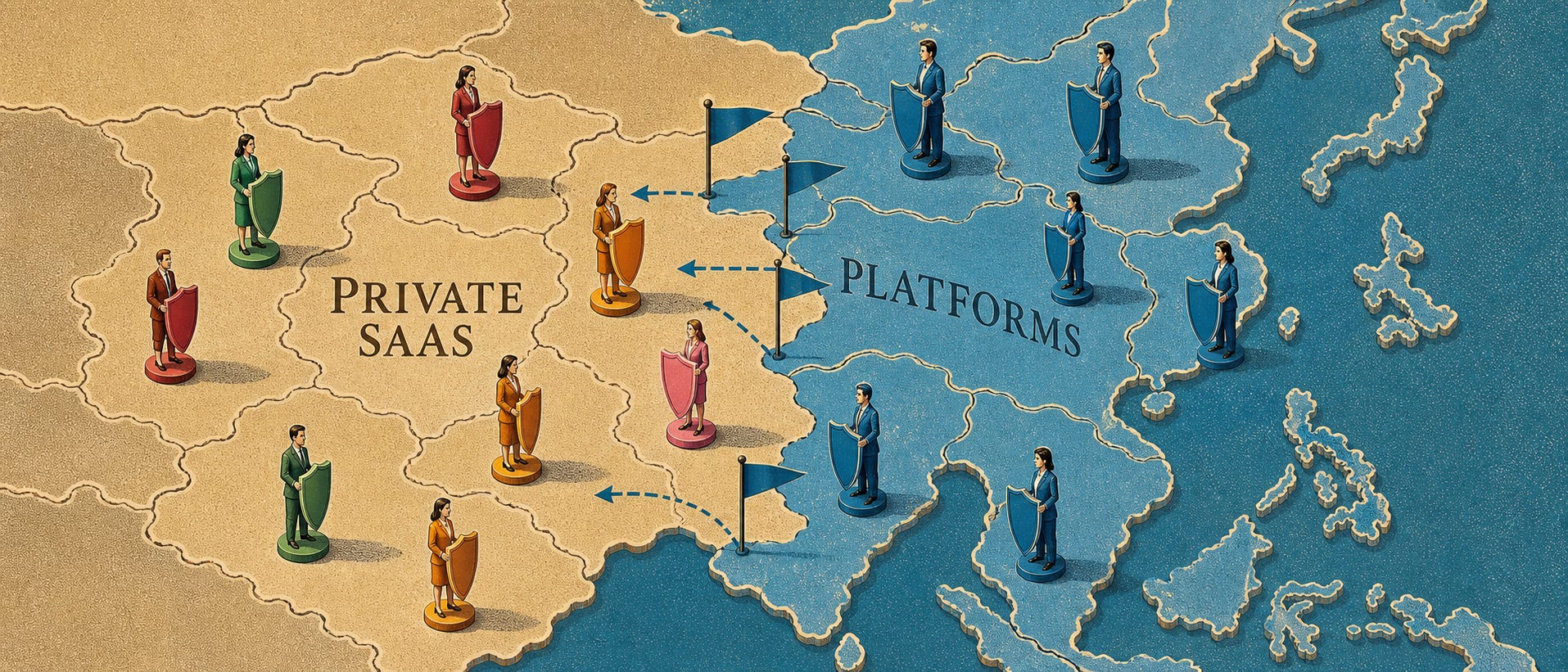
This Wave is Selling to Platforms
I’m not privy to any inside information here, but the signal reads clearly to me. These products and teams made more sense as parts of a larger platform or as feature sets inside existing tooling than as standalone companies.
Look at what’s actually being bought:
Data and signal layers. Where the brand, the agents, and the UI are replaceable, the data layer is the real asset. Warmly’s person-level website visitor ID, folded straight into HubSpot’s contact records. Common Room’s buyer graph, now a signal source inside Zoom. Pocus’ scoring layer. Bluebirds’ prospecting data.
Unstructured conversation data. Forrester calls unstructured data the new battleground. Momentum’s whole job inside Salesforce is piping what customers actually said (across all customer interactions) into Agentforce, instead of what a rep typed into a notes field.
Talent. Koala raised a $15M Series A in February 2025. By July, the engineering team had joined Cursor and the product was sunsetted. There are many cases where the teams decided to wind down altogether (including my company, Groundswell, which was building in this space).
Fin is the outlier here, a distribution buy with 30,000+ customers. Let’s come back to that.

What This Means for Operators
The layer that decides which buyers get pursued (i.e., intent, signals, community, PLG scoring, conversational marketing, agentic prospecting) is moving inside the CRM. Everything upstream of the record is getting pulled into the record itself.
For operators, that means the CRM-neutral signal tool in your stack today is one term sheet away from becoming a feature on someone else’s roadmap.
The next wave of GTM tech is already making acquisitions, too. Rox picked up Persana. Reevo picked up Ciro last week. Even the new guard is shopping before it’s finished displacing the old one — which tells you this isn’t a defensive move unique to legacy platforms. It’s just how GTM tech consolidates now.

3 Phases of AI Adoption
Coding went first.
Cursor crossed $1B in annualized revenue last November and passed $2B by March. Claude Code hit $2.5B within a year of launch. The conditions were perfect. The data already lives in the repo, and the feedback loop is instant (either the tests pass or they don’t). Cursor buying Koala to get ahold of their engineers is what a domain looks like after it’s already won. Coding AI is now rich enough to shop other categories for talent.
Customer support went second.
High ticket volume, measurable resolutions, and a lower risk surface area (lower stakes) when an agent gets something wrong. Back to the Fin example mentioned earlier: Salesforce paying $3.6B for Fin shows that customer support was mature, not sales.
Sales is third in line.
Data is scattered across the CRM, email, call recordings, and LinkedIn, and the feedback loop runs in quarters, not seconds. Anthropic analyzed nearly a million production agent tool calls earlier this year. Software engineering was 49.7% of deployments. Sales and CRM was 4.3%. Which is why every sales-side deal in this wave was small and undisclosed. The big checks in sales haven’t been written yet. And the platforms writing today’s smaller ones aren’t shopping from strength.

Own the Layer, or Become One
Over the last 12 months, HubSpot is down 63%. Salesforce is down 40%. ZoomInfo is down roughly 70% in 2026 alone (96% from its 2021 peak) and now trades below 1x revenue. The market is repricing these names as feature businesses, not platforms in their own right.
The ZoomInfo story deserves a look. They cut 2026 guidance, citing “AI and agentic confusion” and customers building internal AI tooling, then cut 20% of their staff.
Meanwhile, three private companies are leading the charge: Gong crossed $500M ARR growing 55%, pacing to exceed $750M in 2027 (which puts them into the IPO conversation). Apollo crossed $150M in mid-2025 and is growing roughly 40–50%. Clay is around $150M, and growing 150%.
These three are simultaneously the most mature companies in the space and the fastest growing. Maturity and momentum usually trade off. Not here. Other players carry more revenue, but they’ve either plateaued or are in decline.
The difference is ownership: Gong, Apollo, and Clay own their data, their workflow gravity, and their distribution, whereas the acquired companies were mere layers on someone else’s system — Warmly’s first integration was HubSpot; Pocus scored accounts that lived in someone else’s CRM.
When you’re a layer, the platform underneath you is your eventual acquirer or your eventual competitor. This is becoming especially true in the AI era.

The New Guard: AI-Native GTM Tech Companies
Many of the new players are aiming to be both the record and the action in one system from day one, rather than getting absorbed into someone else’s.
The newest crop is aiming at growth the last wave never touched: 3x YoY. Companies like Rox, Attention, Sumble, etc. (Clay half-belongs in this bucket, though they’ve been at it for nine years, which is its own lesson… “New guard” is more an architecture/mindset — AI native, speed of execution — than an age.)
I saw this move in the last wave. Early adopters of Outreach and Salesloft got a real edge before everyone else caught on. The same shape is forming around this crop. (Yes, these companies are built differently under the hood. But the story is the adoption curve, not the model underneath.)

Who Signs the Big Checks
The fastest way to read this market is to follow the buyers.
PE checks in 2021 said GTM tech had built companies worth owning for the cash flow. Platform checks in 2026 say the last generation of point solutions built features. And, if the adoption sequence holds, the biggest checks in GTM tech are still ahead. They’ll be written in sales.
I think that happens inside the next 18 months. The open question is who signs them. If it’s Salesforce and HubSpot again, the old guard bought itself another decade. If it’s one of the new guard that grew into its own system of record, the stack gets rebuilt around a new center of gravity.
The next 18 months will determine if GTM tech has some steak or if it’s all just sizzle.
Brendan Short writes The Signal, a weekly newsletter that breaks down what the best AI-native GTM teams are doing. He has 13+ years of B2B SaaS GTM experience at startups, Zoom Video, and Apollo, and has started two venture-backed SaaS companies in the GTM tech space.
Explore More of Topline
Coming to Terms with My Head Trash & the Parts That “Run” My Life by Kyle Lacy

Helllooo from beautiful Indiana. We are a few months on the other side of the best month in the state (May). The Indy 500. Memorial Day. Our community pool is officially open. I also turned 42. It’s been a whirlwind.
What to Watch Next
 | A guest post by
|