GTM Engineer: The Most Misunderstood Role in Go-to-Market by Brendan Short
A framework for revenue leaders deciding whether to build this capacity now, later, or not at all



Every revenue leader is trying to double their number without doubling headcount. AI is the obvious lever. The less obvious question: who owns building AI-native connective tissue across the GTM org?
Scroll LinkedIn, scan job boards, or drop into any GTM Slack and you’ll see the same answer: the GTM Engineer. (I define GTM Engineer, or GTME, as someone who helps the entire GTM org to build leverage through systems, automation, and AI.)
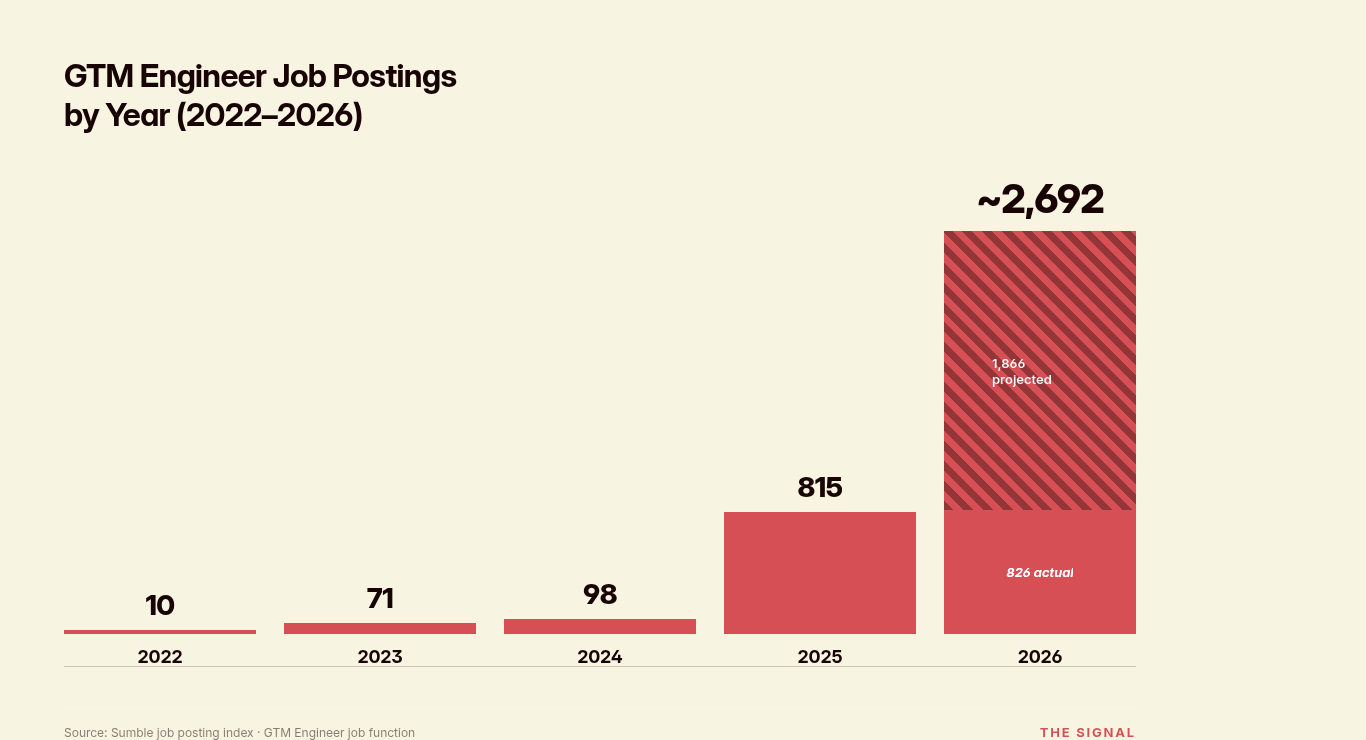
But is the GTME even the right call for your org?
I’ve spent 18 months writing about the rise of the GTM Engineer, interviewing dozens of companies that have hired for the role, and consulting with teams that got it wrong. The pattern isn’t companies skipping the hire, but hiring one before they were ready — or worse, for the wrong reasons.
And so, the better question is whether a GTME is actually the right solution for your company. To answer that, you first need to understand how org charts are changing.

The Post-AI Org Chart Looks Different
The old playbook doesn’t work like it used to: hire a bunch of SDRs, pair them with even more AEs, buy a B2B database, push persona-based sequences.
A new playbook is emerging, and with it, a new staffing model. CROs have to figure out how to scale with AI and automation instead of headcount. Hiring a GTME is one way to do that.
More than half of the fastest-growing B2B SaaS companies have at least one GTME. That’s an order of magnitude higher than the industry average of 3–7% (the lower bound applies when you insist on the literal job title; the upper bound when you include adjacent Growth Engineer and GTM-scoped RevOps Engineer roles).
But hiring a GTME doesn’t automatically fill AEs’ calendars. The value depends entirely on where you point them.

Where to Actually Point a GTM Engineer
GTM means “go-to-market,” not top of funnel and not lead gen. The full motion covers every team that touches a customer, from awareness to renewal.
Most companies get this wrong. They hire someone technical, point them at Clay and Instantly/Smartlead, and ask them to “scale outbound.” While that can be a legitimate use case for companies with low ACV and massive TAMs (e.g., Ramp, Rippling, Stripe), it’s the lowest-value version of the role. If your GTME is only automating cold outbound, you’ve hired a sequence builder, not an engineer.
Other common misuses:
As a band-aid for a broken process. If your team doesn’t have a working playbook today, a GTME can’t fix that. Their job is to scale what works, not invent it. Automating a process your reps don’t know how to run will only accelerate failure.
As a replacement for strategy. GTMEs need tight collaboration with the CRO, CMO, and CEO on ICP, personas, messaging, offers, and what “good” looks like. Without that, you get impressive-looking workflows that don’t translate to pipeline.
As a substitute for hiring reps. A GTME multiplies the output of a team. A multiplier on zero is still zero.
Think of it like a NASA mission: Reps are the astronauts, running meetings, negotiating deals, managing relationships. The GTME is mission control, building the systems that get those astronauts to the right destination with the right data, at the right time.
The best GTMEs build the groundwork that powers the mission:
Enrichment and scoring workflows that tell reps which accounts are worth their time right now based on real signals like hiring data, funding, tech installs, product usage, and G2 activity, rather than static lists from six months ago.
Automated handoffs between marketing, SDRs, AEs, and CS. Pipeline leaks live in those gaps, and good GTMEs find and close them.
Feedback loops that pinpoints which campaigns, segments, and messages actually drive revenue and not just activity.
Proven plays scaled across the full customer lifecycle. Renewal triggers, expansion signals, onboarding workflows churn risk detection. Signal detection and action, operationalized.
At the most basic level, ask yourself: Do you have a playbook that works today, even if it’s manual? If yes, a GTME can scale it. If no, you have a strategy problem, not a GTME problem. (I go deeper on this in When Should You Hire a GTM Engineer?)

How to Know It’s Working
This is where a lot of revenue teams struggle. They’ve hired a GTME, the person has built a bunch of workflows, and leadership has no idea whether any of it is working.
Positive signals to look for:
Reps are spending more time selling. If AEs are still manually researching accounts, building lists, drafting cold emails from scratch, creating decks, or scanning for warm intros, the GTME isn’t having impact where it matters.
Pipeline from automated* workflows is growing. Not email volume. Not leads. You need actual pipeline that leads to net-new and expansion revenue. (*Many of the best GTME-built plays have a human in the loop for the last mile, so “fully automated” is a misleading metric.)
Speed to lead is compressing. From signal to action, how fast can your team move? A GTME should be shrinking that window meaningfully.
The team is running experiments, not just campaigns. The best GTMEs constantly test new signals, segments, messaging, and channels. The best teams I see ship three to four experiments a week, and often more. That pace is only possible with AI on board.
The modern playbook is more about turning existing talent into superhumans than replacing humans with AI agents. The goal is to empower a small team to operate at enterprise scale. The best revenue teams haven’t automated their people away; they’ve reimagined how humans and AI work together. GTM Engineers help to drive that change.

Who Shouldn’t Hire One
Not every company needs a GTME. That’s fine.
Varun Anand, co-founder at Clay, put it well: “You shouldn’t hire a GTME if you don’t manage your GTM in a centralized way with systems and tools. Then a GTME would have nothing to do and you should focus on sales enablement. Brokerage businesses, for example, would not benefit from a GTME…. But any business that takes a centralized view of their GTM and can run experiments at scale across their team should hire one.”
Think twice if any of the following describe your org:
Pre-product-market-fit. If you’re still figuring out who your customer is and what they care about, there’s nothing to scale. The better spend is on discovery, not automation.
Fewer than three to five reps. The GTME ROI doesn’t kick in until there’s enough volume and headcount to justify the investment. A founder, a scrappy AE, or a fractional GTME/agency can often run the playbook manually at that size.
Leadership can’t articulate the ICP or the sales motion. A GTME needs inputs: Who are we targeting? What triggers should we act on? What does a good lead look like? Without clear answers, you’re asking someone to automate ambiguity.
You think this is a “set it and forget it” hire. GTM Engineering is continuous. Workflows break. Data degrades. Markets shift. If you want to build a machine and walk away, you’ll be disappointed.

The Compounding Advantage
If none of the above describes you — you have a working playbook, a team executing consistently, a clear ICP, and manual processes eating your people alive — then the question isn’t whether to build this capability. It’s how fast can you build it before your competitors do.
Before you open the req, pressure-test three things:
Can you write down your working playbook today, in detail, without making things up? If not, you’re not ready. Fix the playbook first.
Do your CRO, CMO, and CEO agree on ICP, motion, and what “good” looks like? If there’s daylight between them, a GTME will surface that misalignment painfully. Align first, hire after.
Are you prepared to treat this like a product function, not a project? That means ongoing investment, continuous iteration, and a leader who protects the role from becoming an outbound automation shop.
My prediction: Within the next 18 months, more than 80% of B2B companies between Series A and IPO will have a GTME (or someone doing this work under a different title) embedded in their GTM org.
The teams that hire now, and scope the role correctly from day one, will build a competitive advantage that compounds. The ones who rush the hire without the prerequisites will spend a year figuring out why their expensive new engineer is shipping workflows nobody uses.
Either way, this capability is becoming table stakes. The only real question is whether you build it deliberately or reactively.
Brendan Short writes The Signal, a weekly newsletter that breaks down what the best AI-native GTM teams are doing. He has 13+ years of B2B SaaS GTM experience at startups, Zoom Video and Apollo, and has started two venture-backed SaaS companies in the GTM tech space.
Explore More of Topline
Read our previous post with Eric Janssen, Founder-turned-Professor, Ivey Business School at Western University; Limited Partner, Stage 2 Capital

What to Watch Next
The #1 GTM Engineer In The World
How To Optimize Exec Performance
 | A guest post by
|
thanks for having me on!
very honored 🫡
I agree with this 100%. I worked for a couple of early-stage startups in SF as a Founding GTME, and the role was very undefined, often leaning more toward developing the strategy, experimenting, and scaling it as well —kind of a hybrid between a GTME and an AI Growth Specialist. I think this year is going to be crucial as companies figure out what the role of a true GTME is, especially since there are so many startups automating different parts of the GTM pipeline that founders can plug in and experiment with.